
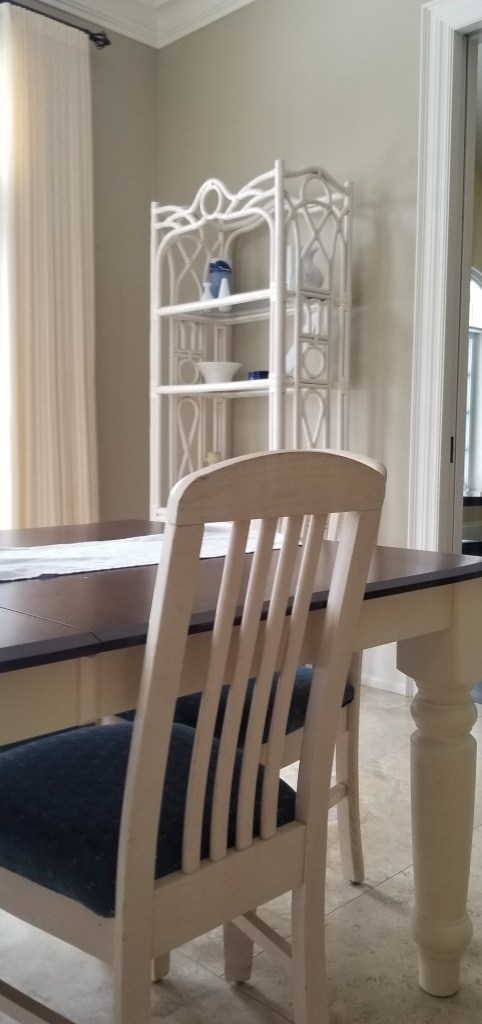
This post is about interior paint colours and what affects them. I have chosen this topic because recently, I have been doing several consultations with homeowners who wish to carry out their updated room projects or renovations themselves. One of these consultations involved a colour consultation. The homeowner wanted to paint her primary rooms either white or gray. Choosing a white, gray or beige paint colour can be challenging. But some tips can help you pick a paint colour that will work for you.
So I have included tips about what to consider when you choose your paint colours. For example, I will talk about how the undertone can affect the way the colour will look in your room. I will also discuss how sunlight can affect how your paint colour will look. How reflective your paint colour is can also affect the look of the paint colour in your room. Furthermore, other colours close to your wall can affect how the paint colour looks.
During the consultation, the homeowner said she did not like the green that her living room walls sometimes flashed. There are some reasons why this can happen, and this post will discuss these factors.
Why are my Gray Wall Colours Turning Green?
There are a few reasons why this may happen. In this post, I will talk about a number of them. It is almost like you have to be a detective to figure it out! It could be about the undertones in your paint or the furnishings in the room. Or it could be the exposure in your room. Or it could be the LRV of the paint colour. So what is LRV, you may ask? That is the first factor that I will discuss.
Reason #1: High Reflectance Value
Consider how light or dark the colour you choose is. Look at the colour’s LRV to find this out. The LRV of your paint colour affects the light reflected by the paint and the colours reflected by the colour. Colours with an LRV (light reflectance value) of 50% or higher will be lighter coloured and bounces back a lot more light into the room than is absorbed. The higher the LRV, the more light it reflects and the lighter coloured the paint colour. That is why white paint lightens and brightens a room.
White has a high LRV and reflects a lot of light, but it also reflects colours in its environment, such as green from the trees outside your window. So if you have a large window with many trees and grass close to them, then the green will reflect onto your white or light gray walls. If there is a lot of grass or trees outside your window, the sun grabs that green and reflects it on the walls. So if you do not want your walls to look green in the summer, choose a darker colour.
If you still want a room to appear light but do not want the greenery from outside your windows to be reflected on your walls, choose a colour with an LRV between 55 to 65. It will still reflect light but not a colour found outside your window. So if you want a gray or beige wall in your home that does not reflect the colour of your grass outdoors, choose a colour within this range.
Reason #2: Undertones in your Paint
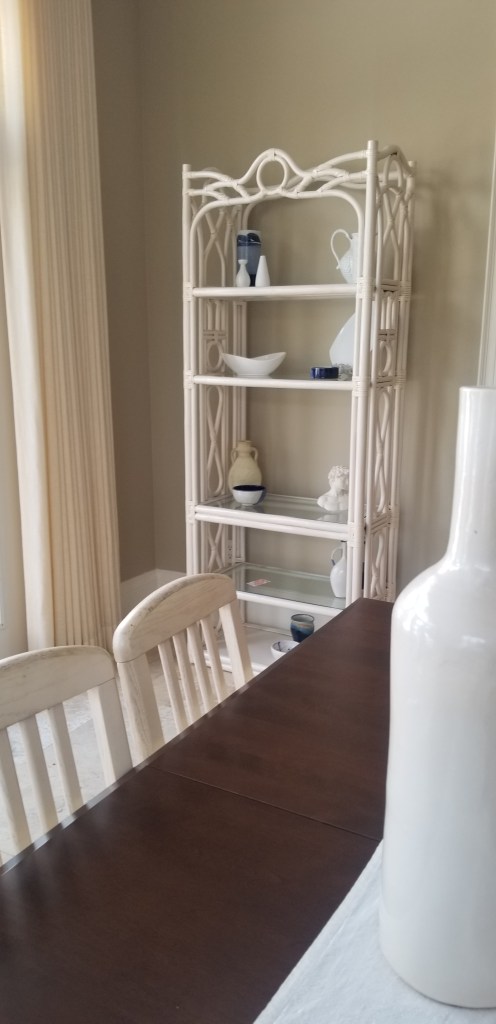
Tip number two is to consider the undertone in your paint. Every paint colour, including white, gray and beige, has an undertone. So pick a colour with an undertone you like. For example, Bleeker beige (HC80) by Benjamin Moore has a gray and yellow-gold undertone. It has more yellow than gray, tipping it into the beige category. But its high percentage of gray creates a soft, subtle beige.
In the photo below, you can see that where the sun is shining on it, there is a slight gray and gold hue. That golden colour is called the undertone. In some places on the wall, it looks like a yellow-orange colour. But most of the wall colour seems a bit more gray-green. Why is that?
Reason #3 North Facing Windows: Sunlight Can Effect Colour
Bleeker beige has a little colour, so it is considered a neutral paint colour. It has a fair amount of gray, so this shade leans into hints of gray. Bleeker beige can look even greyer in a room with north-facing windows. The gray-blue light from a north window can make this beige look a tad gray-green. And the light in winter can make it look like a true gray. The gray northern light looks even grayer in the winter. So if you like a deep warm gray colour for your north-facing room, then bleeker beige may be for you.
Many homeowners, including myself, love the warm gray that warm grays and warm beige colours like bleeker beige have in a north-facing room. I took the photo on a February morning. The blue northern lights balance the golden hue of the bleeker beige, making it look gray. The blue light from the north-facing window and the yellow undertone react with each other to create a bit of green. It is subtle, though.
We like green, so we do not mind that the blue winter light sometimes turns parts of the wall a tad green, but my client did not like green undertones. The light in your room can affect the paint colour you choose, so it is important to be aware of that. So make sure you consider the type of light exposure your room has. Is it east, west, or south or north-facing? It is essential to consider the natural light that comes into the space when choosing the colour for the room.
This room has an east-facing room too. As a result, in the morning, the yellow light of the sunlight also streams into the room. So the yellow light from the morning sun brings out the golden colour of Bleeker beige.
Click on the link below if you want to find out more about how sunlight affects paint colours or if you want to find out how to pick exterior paint colours. ttps://lynteriors.wordpress.com/2022/11/08/how-to-pick-exterior-paint-colours/
Reason #4: Simultaneous Contrast
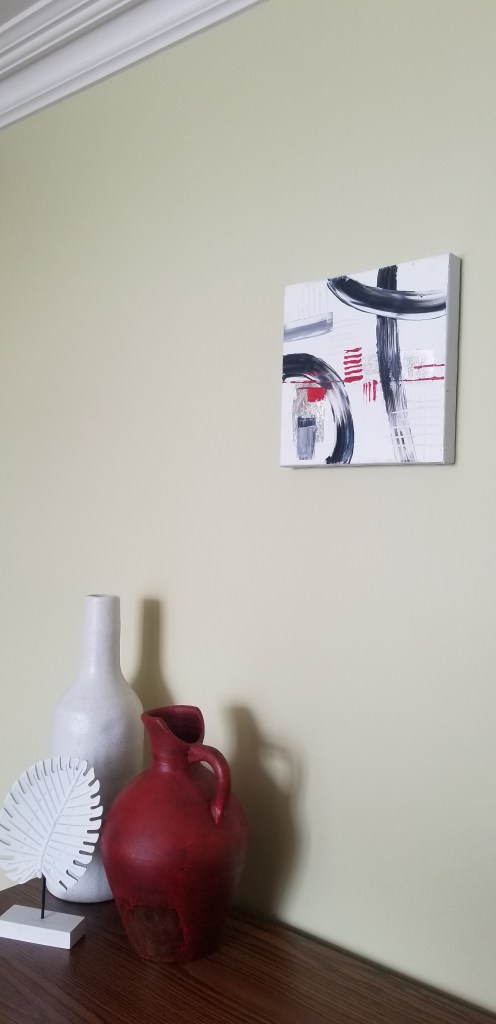
When I was studying interior decorating at Seneca college, my colour theory professor Kelly Tomkins, had us do an assignment about a phenomenon called simultaneous contrast. It has to do with the rules of colour theory. One of the rules stated, “if 2 complimentary colours lie adjacent to one another, each seems more intense than by itself.” So if you have red accessories such as this vase and red wall art, the red accessories will look redder, and the green undertone on the wall paint will look greener. My client had a red abstract wall art on the wall in the living room, which probably increased the perception of the intensity of the green undertone on her wall.
In conclusion, if you choose white, gray or beige paint colours for your home, be aware of their undertones. Also, make sure you like the colour under all lighting conditions.
One way to test the colour on your walls is to use Samplize by Benjamin Moore. Stick the Samplize on your walls. If you see the undertone, make sure you do not mind the undertone in your room. Also, see how the paint looks throughout the day and under artificial light. Remember to check it at night under artificial light, especially if you spend a lot of time in the room in the evening.
After reading this post, your curiosity may have been piqued. And you may want to know how to pick exterior paint colours too. Similar rules apply. Click the link below to find out how to choose an exterior paint colour. This post goes into more detail about how the sun affects paint colour. It talks about how south-facing, east-facing and west-facing sunlight on walls affects paint, too. ttps://lynteriors.wordpress.com/2022/11/08/how-to-pick-exterior-paint-colours/

I, Lynn Asbury, am the founder of Lynteriors which provides interior decorating services in Aurora, Ontario. My passion is making spaces beautiful, comfortable, and suitable for your lifestyle.

 Lynteriors